Pregnancy can increase a household’s priority for homelessness assistance, but it does not automatically guarantee an immediate permanent council house.
The fastest appropriate route depends on whether the applicant is already homeless, likely to lose their accommodation, living somewhere unsafe or simply seeking a more suitable home.
In England and Wales, a pregnant woman is generally treated as having a priority need when homeless. Scotland no longer uses the priority-need test, while Northern Ireland assesses applicants under its own homelessness tests and housing-points system.
Anyone who has nowhere safe to stay should contact the council’s homelessness or housing-options team immediately rather than relying only on an ordinary housing-register application.
What Is the Fastest Way to Get Housing Help While Pregnant?

The most important step is to use the correct application route. Joining the general housing register and making a homelessness application are related but separate processes.
1.Contact the Council Before Losing the Current Home
An applicant should contact the local authority’s housing-options or homelessness team as soon as there is a genuine risk of losing accommodation.
In England, where the council has reason to believe that an applicant may be homeless or threatened with homelessness within 56 days, it must assess the applicant’s circumstances and eligibility for assistance.
This assessment should identify the causes of the housing problem, the household’s accommodation needs and the support required.
Examples of evidence showing a risk of homelessness include:
- A valid eviction notice;
- A letter from relatives asking the applicant to leave;
- Mortgage-possession correspondence;
- Evidence that accommodation is unsafe;
- Domestic-abuse evidence;
- Hospital or social-worker reports; or
- Proof that temporary accommodation is ending.
Waiting until the final day can make it harder for the council to prevent homelessness or find an appropriate placement.
2.Make a Formal Homelessness Application
A pregnant person should clearly state:
“I am pregnant and homeless, or threatened with homelessness, and I want to make a homelessness application.”
An enquiry about council housing is not always treated as a formal homelessness application. The applicant should ask for an assessment and retain a written record of the request.
In England, the council’s relief duty normally lasts for 56 days unless it ends earlier for a specified legal reason. Where the authority has reason to believe that a homeless applicant may be eligible and may have a priority need, it must provide interim accommodation while making enquiries.
Interim or temporary accommodation could be:
- A hostel;
- Self-contained temporary housing;
- A hotel or bed-and-breakfast placement;
- Housing outside the immediate council area; or
- Accommodation managed by a housing association or private provider.
This accommodation is not necessarily the permanent council home the household ultimately wants.
3.Provide Proof of Pregnancy Immediately
The council may ask for evidence from:
- A midwife;
- A GP;
- A hospital maternity unit;
- An antenatal clinic; or
- Another appropriate medical professional.
In England, official homelessness guidance says normal confirmation from a medical professional should be adequate and that priority need applies irrespective of how long the woman has been pregnant.
Applicants should not delay contacting the council simply because a MATB1 certificate has not yet been issued. A midwife or GP letter may be accepted earlier.
4.Submit a Complete Evidence Pack
Incomplete applications can delay assessment. The council may request:
- Photographic identification;
- National Insurance details;
- Proof of immigration or residence status;
- Recent bank statements;
- Benefit or earnings evidence;
- Tenancy agreements;
- Eviction notices;
- Address history;
- Details of everyone in the household;
- Medical or disability evidence;
- Pregnancy confirmation; and
- Evidence of domestic abuse or other risks.
Local authorities frequently ask for household details, address history, health information, immigration status and supporting documents when assessing housing-register applications.
Copies should be clear, complete and submitted through the council’s accepted method. The applicant should retain screenshots, email receipts and reference numbers.
5.Explain Why the Existing Accommodation Is Unsuitable
Pregnancy does not necessarily make otherwise suitable accommodation legally unsuitable. However, the council should be told about any factors that create a genuine housing or welfare need.
Relevant circumstances may include:
- Serious overcrowding;
- Unsafe stairs or inaccessible facilities;
- Severe damp or mould;
- Domestic abuse;
- Harassment or violence;
- No access to cooking or washing facilities;
- Medical complications;
- A risk of street homelessness;
- An unreasonable distance from essential treatment; or
- Accommodation that the household has no legal right to occupy.
In England, accommodation secured under homelessness duties must be suitable for the applicant and the members of the household who normally live with them or may reasonably be expected to live with them.
Supporting evidence should explain how the property affects the pregnant person rather than simply stating that the home is inconvenient.
Does Pregnancy Move Someone to the Top of the Council List?

Not automatically.
Pregnancy can establish priority need under homelessness law, but councils allocate permanent social housing according to their local allocation schemes.
These may use:
- Priority bands;
- Points;
- Medical or welfare categories;
- Reasonable-preference groups;
- Waiting time;
- Property-size eligibility; and
- Local connection or residency criteria.
In England, councils must operate published allocation schemes that define how priority is determined. However, councils retain substantial control over their qualification criteria and allocation procedures.
Therefore, two pregnant applicants living in different council areas may receive different housing-register bands even when their circumstances appear similar.
Homelessness Priority Is Not the Same as an Immediate Council Tenancy
A council may satisfy its homelessness duties through temporary accommodation or, depending on the legal framework and circumstances, a suitable offer outside traditional council housing.
The realistic sequence may be:
- Homelessness assessment;
- Emergency or interim accommodation;
- Prevention or relief work;
- Temporary accommodation;
- An offer of settled housing when suitable accommodation becomes available.
A settled offer may take time because social-housing demand frequently exceeds supply. Official guidance warns that applicants are not guaranteed a council property merely because they have joined a waiting list.
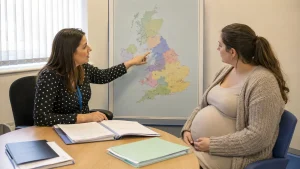
How Do the Rules Differ Across the UK?
England
A pregnant woman and anyone living with her or reasonably expected to live with her—has priority need if homeless. There is no minimum stage of pregnancy for this category.
The council must assess an eligible applicant who may be homeless or threatened with homelessness within 56 days.
Where there is reason to believe that a homeless applicant may be eligible and in priority need, interim accommodation should be provided while enquiries are completed.
However, eligibility, intentional homelessness, local connection and the suitability of offers can still affect the final duty.
Scotland
Scotland abolished the priority-need test in 2012. Local authorities have statutory responsibilities towards people who are homeless or threatened with homelessness and must provide at least advice, assistance and temporary accommodation.
Pregnancy remains highly relevant when assessing the suitability of temporary accommodation. Scottish rules restrict councils’ use of unsuitable temporary accommodation for pregnant women and households with children, subject to limited exceptions.
Wales
In Wales, a pregnant woman is a priority-need category under the Housing (Wales) Act 2014 framework. Someone is generally threatened with homelessness where it is likely that they will become homeless within 56 days.
The local authority will normally consider eligibility, homelessness, priority need and whether any longer-term accommodation duty applies.
Applicants should note that proposed Welsh homelessness reforms do not necessarily represent rules already in force. Current applications must be assessed under the law and guidance operating at the time of the decision.
Northern Ireland
In Northern Ireland, homelessness applications are handled by the Northern Ireland Housing Executive.
Applicants are assessed under four principal tests:
- Eligibility;
- hHomelessness;
- Priority need; and
- Intentionality.
Social-housing applications are prioritised through a points system. For example, the Housing Executive currently lists 70 points for applicants accepted as homeless or threatened with homelessness, although the final total depends on all applicable circumstances.
What Can Improve a Housing Application?

There is no legitimate shortcut that guarantees a council property. However, applicants can prevent avoidable delays and ensure that their real needs are properly recorded.
Keep the Application Updated
The council should be told promptly about:
- Confirmation of pregnancy;
- A change in due date;
- A new eviction notice;
- Deterioration in health;
- Domestic abuse;
- A relationship breakdown;
- Changes in household members;
- The birth of the baby; or
- The loss of temporary accommodation.
An applicant already on the housing register should request a reassessment after a material change rather than assuming the application will update automatically.
Ask for the Written Allocation Policy
The applicant should obtain the council’s current:
- Housing-allocation scheme;
- Medical-priority policy;
- Homelessness policy;
- Bidding rules; and
- Property-size standards.
These documents explain what evidence is required and how bands or points are awarded.
Bid Regularly and Realistically
Where the council uses choice-based lettings, applicants may need to bid for advertised properties.
Restricting bids to one small neighbourhood, one property type or unusually specific features may substantially reduce available options.
Applicants should still consider safety, healthcare, childcare and support networks, but greater flexibility may improve the likelihood of receiving a suitable offer.
Consider Housing Associations
Housing associations provide social housing alongside councils. Some accept direct applications, while others allocate homes through local-authority nomination schemes.
Official guidance states that housing-association applicants may remain on waiting lists for a long time until a suitable property becomes available.
Applying through every legitimate route available in the area can improve the range of options, although duplicate applications do not create additional legal priority.
Get Supporting Professional Evidence
Useful evidence may come from:
- A midwife;
- A health visitor;
- A GP or consultant;
- A social worker;
- A domestic-abuse support service;
- An occupational therapist;
- A probation officer; or
- A housing adviser.
Effective professional evidence should explain the specific housing impact, risks and required property features. A brief letter simply confirming that someone is pregnant may establish pregnancy, but it may not prove an additional medical or welfare need.
What Are the Mistakes That Can Delay or Harm an Application?

Leaving Suitable Accommodation Voluntarily
An applicant should obtain housing advice before surrendering a tenancy, abandoning accommodation or asking a landlord to end an agreement.
In some circumstances, a council may investigate whether the applicant became homeless intentionally by giving up accommodation that was reasonable to continue occupying. This can affect the longer-term housing duty, although the exact rules differ across the UK.
Providing Inaccurate Information
False statements about pregnancy, domestic abuse, household members, residence or eviction could result in:
- Removal from the housing register;
- Withdrawal of an offer;
- Recovery of a tenancy;
- Fraud investigations; or
- Prosecution.
Every statement should be accurate and supported where evidence is available.
Ignoring Council Correspondence
Missed telephone calls, bidding deadlines or evidence requests can stall or close an application. Contact details should be kept current, and applicants should check email spam folders and online housing accounts regularly.
Refusing an Offer Without Advice
Applicants may have the right to challenge the suitability of an offer, but refusing it outright can carry serious consequences.
In England, refusal of certain final accommodation offers may prevent the applicant from later being owed the main housing duty. The council should consider the applicant’s circumstances and reasons, but legal advice should be obtained before refusal wherever possible.
Conclusion
Pregnancy can provide important protection when someone is homeless or at risk of homelessness, but it does not guarantee an immediate council house.
The best approach is to contact the local council as early as possible, provide complete supporting evidence and ensure the correct homelessness or housing application is made.
As housing policies differ across the UK, applicants should follow their local authority’s guidance and seek independent housing advice if they disagree with a decision or need urgent support.
FAQs
Can pregnancy help someone get a council house faster?
Pregnancy may increase priority for homelessness assistance, but it does not guarantee an immediate permanent council home.
How many weeks pregnant must someone be to qualify for priority?
In England, there is no minimum stage of pregnancy for priority need under homelessness law.
Can a pregnant woman get emergency accommodation?
Yes, where she is homeless, eligible for assistance and the council has reason to believe she may have a priority need.
Does pregnancy move someone to the top of the housing list?
Not automatically. Each council uses its own allocation bands, points and housing-need criteria.
What proof of pregnancy will the council accept?
A letter from a midwife, GP, hospital or maternity service is usually accepted as evidence.
Should someone wait until they are homeless before contacting the council?
No. The council should be contacted as soon as homelessness is likely, especially within the next 56 days in England or Wales.
Can someone apply while staying with family or friends?
Yes. A person may still be homeless if they have no legal right to remain or the arrangement is no longer reasonable.
How long does it take to get a council house while pregnant?
There is no fixed timescale. Emergency accommodation may be arranged quickly, but a permanent social home may take much longer.
Can overcrowding increase housing priority?
It may increase priority if the home is legally overcrowded, unsafe or unsuitable under the council’s allocation policy.
Note: This article has been reviewed against official UK government, devolved government and local-authority homelessness guidance.